Hello, friends! It’s time to get back to our regularly scheduled programming of nerdy shenanigans. As much as I’m still pondering Quiet and how flippin’ amazing it was, my last few weeks have been filled with heavy thoughts and discussions, and I’m in the mood for something with a bit more levity. And what better thing to choose than the wonderful world that is tabletop gaming? Tabletop gaming (or as normal people like to call it, board games) is one of my more recently acquired nerdy pastimes. I of course played the old standbys like Monopoly (horrors…), Scrabble, Sorry, checkers, Clue, etc. as a child, but I didn’t know then what I know now — those tried-and-true games are just the tip of a very, VERY big iceberg.

Ernie knows; he finds our chunk of that iceberg to be a pretty solid hiding spot.
I mostly have my extremely gaming-savvy husband to thank for introducing me to the near-infinite possibilities that board-gaming offers, as well as a few friends who knew (and still know) way more about it than I do. They showed me that board games aren’t just for family night and half-hearted youth group activities anymore — oh no; you can be part of entire stories now. And since trying to live inside of stories is what I tend to spend much of my waking hours doing, this was a pretty exciting discovery.
Fairly early on in my foray into the vast realm of board games, I decided that by far my favorites of the new games I’ve been lucky enough to play are just about any sort of cooperative game. There are a few reasons for this. For one thing, I’m not a very competitive person and tend to lose most regular board games, which is usually fine but gets old after a while (at least when we inevitably lose cooperative board games, we all lose together!). And for another, most allow for more group involvement throughout so that you’re not sitting around waiting for it to be your turn again (granted, most people would be strategizing during these lulls, but why on earth would I ever employ strategy?? Let’s not get too crazy here). Also, cooperative games tend to be more story-based than other types, which, as I said before, I am all about. It all adds up to the perfect gaming formula, at least as far as I’m concerned.
And there are still lots of cooperative games out there that I’d love to try, but for now, here are my favorites:
1. Lord of the Rings

Okay, so I was already predisposed to love this game, and I would probably still love it even if it were crappy. But crappy it most certainly is not. Out of all the cooperative games I’ve played thus far, this one seems to me to be one of the best designed, best paced, and most beautiful.
One of my favorite things about this game is that it predates the movies, so the artwork is done by John Howe, (who ended up doing a lot of the concept art for the films, as it happens), and the characters look nothing like any of the actors, which I kind of love. Since the game is pre-films, this also means that the storyline is faithful to the books in ways that the movies weren’t, or in some cases, couldn’t be, which gives the story new life in a really interesting way.
Each person plays as one of five hobbits: Frodo, Sam, Merry, Pippin, or Fatty (Fredegar) Bolger. Fatty Bolger, you guys! Who doesn’t even show up in the movies — he’s that great character from the books who the other four hobbits ask to join them on their journey as they’re fleeing the ringwraiths and is like “LOL, nope.” He gets a second chance to come along in the board game, whether he wants one or not. Sadly, I haven’t gotten to play as him yet, but someday I’ll be playing in a group of five and will be able to.
There is only one way to win the game–you must get past Moria, Helm’s Deep, Shelob’s Lair, and Mordor and throw the One Ring into the fires of Mount Doom (obviously). However, there are a bunch of ways to lose, and just when you think you’re doing well, you fall right into one of them. I think I’ve only been part of one winning session of this game, and losing a cooperative game is heart-wrenching enough; with LOTR, you have the added misery of knowing you’ve failed Middle Earth and condemned it to hundreds of years of subjugation and, eventually, complete and utter ruin. Isn’t it great?!
But seriously, you guys. The stakes are high, the artwork is amazing, and the gameplay pulls you in almost as much as the stories themselves do. Do yourself a favor and play this one!
2. Pandemic

This one is either a close second to LOTR or ties for first as far as my favorites go; I can’t decide. It’s another world-saving game, and in this one, you must work with your fellow players to cure and eradicate four deadly diseases that threaten to take over and plunge humanity into the apocalypse.
At the beginning of the game, each player is randomly assigned their role (such as Medic, Dispatcher, Researcher, etc.), and each role has different abilities. For example, the Medic can cure a whole city in one action instead of several, or the Quarantine Specialist can keep an outbreak from happening in any city they’re connected to. The players must work together to keep the different diseases from outbreaking and spreading farther, all the while working to eradicate them.
Much like LOTR, there are a TON of ways to lose this game, and the one way to win is nigh impossible to achieve. This is another one I’ve only been part of a winning session once or twice, and even then we were playing at the “easy” level. But all those losses somehow haven’t made this game any less fun; the second you lose the game, you just want to start up another round and see if this time, you can get the optimal combination of role cards, or manage to wipe out a disease early on, or some other strategy that will TOTALLY MAKE YOU WIN THIS TIME FOR REALS.
My favorite thing about this game is that it has probably the most group involvement of any I’ve played. Even more than LOTR, it requires the whole team to be constantly strategizing together and contributing ideas about what the group’s next step should be, which makes the game feel really fast-paced and exciting; even when it’s not your turn, you’re still a vital part of the process. It has all the elements that make co-op games great, and just talking about it is making me want to go play it!
3. Castle Panic
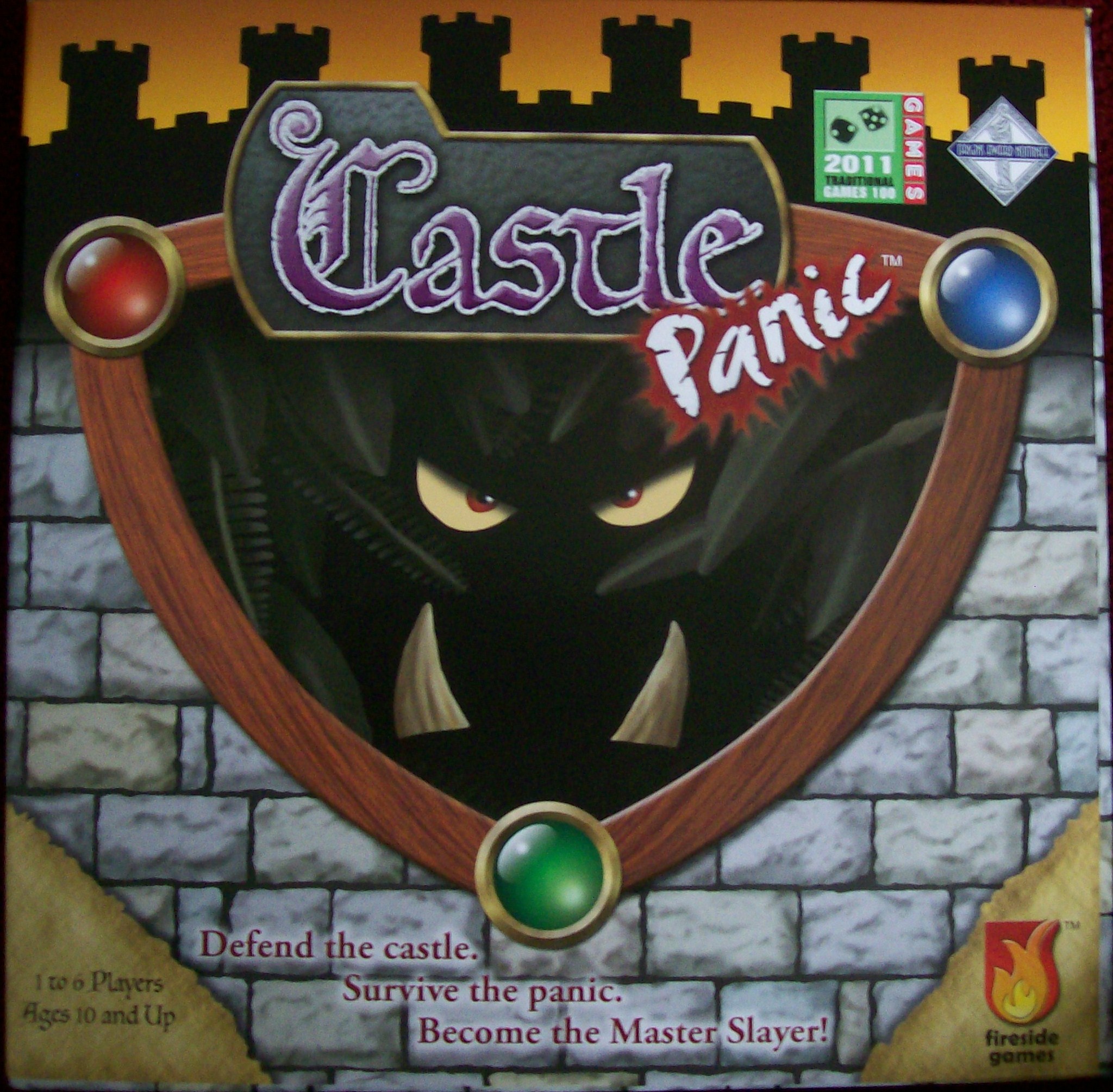
This one is probably the simplest of my favorites, and by far the most lighthearted, despite the presence of various monsters. The object of this game is to protect your walled-in castle, which stands at the center of the board, from the attacks of assorted orcs, trolls, goblins, and the occasional giant boulder. Each turn, new monsters appear from the forest into one of four colored quadrants, and move down one ring every time each player has had a turn. Players can attack the monsters heading toward the castle as long as they have a card that corresponds to the colored quadrant and ring a monster is currently in (for example, a red knight or a green archer).
It feels complicated written out, but it isn’t in practice, which is one thing I like about this game; it’s simple enough to pick up quickly, but tricky enough and luck-based enough to make it challenging. It’s a pretty fast one to play, too, which is nice because, if you lose, it’s easy to play another round and try to beat the monsters again, which you will immediately want to do. In short, this game is quick, simple, and has just enough story-ness about it to keep you invested in the safety of your castle.
4. Betrayal in the House on the Hill

Arguably the spookiest of the cooperative games I’ve played, I think of this one as a glorified version of Clue — you’re given a mysterious scenario to solve as a group by traveling through the various rooms and levels of a scary, decrepit old house full of things like burned-out rooms and mysterious splotches on the walls. It’s easy enough until the Haunt happens and one of the other players who’s supposedly been on your side the whole time suddenly betrays you!
The rest of you must then both fulfill the win conditions of your scenario while trying to keep the betrayer from picking you off, one by one. The great thing about this one is its variety — there are dozens of scenarios to play through, each with its own win conditions and betrayer, both of which are assigned at random. Add that to the fact that you (or at least I, because I’m a giant wimp) are bound to get just a little creeped out by the story you’re immersing yourself into, and you have a game with a lot of great depth and intensity that makes you want to keep coming back to see what creepy story you can get yourself embroiled in next.
5. Elder Sign

Capitalising on the Lovecraftian flavor that most of nerddom seems to have taken on lately, this game puts your group in a spooky museum, wherein you must keep the gates to another dimension shut to prevent The Old One or Cthulu or Azathoth or some other of H.P. Lovecraft’s horrors from appearing and destroying the world.
Elder Signs is kind of Arkham Horror lite, for those of you who have played that one, and is great for getting into the Lovecraftian world when you don’t want to spend half a day there. What I like most about this game is the creepy factor — from the flavor text to the artwork to the setting itself, it’s so delightfully spooky and otherworldly, while being vaguely steampunk. It’s a really cool aesthetic, and makes the game both delightfully nerdy and compelling enough to keep you coming back to it.
A downside to this one is that it’s really complicated–it has a lot of pieces, a lot of cards, and a lot of incidental rules that are hard to remember. I’ve played this one a few times, and it seems like we’re always discovering some rule about something we’ve been doing wrong the whole time. Another con is that this one has probably the least amount of group involvement and highest amount of individual decision-making of any co-op game I’ve played. This is really sort of a personal downside; as a poor strategist who would rather work together with a group and defer the final decision to someone else, I sort of have to work myself up to play this one (in other words, I am a lazy bum).
That said, I do enjoy this game quite a bit — the stakes are high enough to keep things really exciting, but the difficulty level is just low enough (but only barely just) to allow players to actually win the thing once in a while, which is immensely satisfying.
—————
So there you have it, friends! Have you played any of these games yourself? What were your thoughts? What other co-op games have you played and loved? Let’s hear it!


